
Bonjour,
Vous recevez la newsletter Parlons Futur : une fois par semaine au plus, une sélection de news résumées en bullet points sur des sujets tech 🤖, science 🔬, éco 💰, géopolitique 🌏 et défense ⚔️ pour mieux appréhender le futur 🔮.
Je m'appelle Thomas, plus d'infos sur moi en bas d'email.
Voici donc ma dernière sélection !
L’apéro
Voitures volantes : le constructeur de voitures électriques chinois Xpeng fait la première démo publique à Dubai de son engin volant (vidéo de 2 min) à deux places. Bon vol à vide et pas très haut, un peu décevant... Son rival chinois EHang en mai dernier déjà faisait des tests avec passagers à bord (vidéo de 2 min bien plus impressionnante)
et pendant ce temps aux US : Boeing-backed Wisk Aero reveals a four-seater autonomous air taxi that can fly without a human pilot and is in a race to become the first "electric vertical takeoff and landing" aircraft to get the green light for passenger testing in the US (la démo vidéo), bon pas de vol, mais celui-là a des ailes en plus de ses rotors contrairement aux drones chinois
Armes autonomes : a Chinese defense contractor demonstrates a large flying octopter drone dropping off a gun-carrying robot dog (1-min video, source)
Pendant ce temps-là, Boston Dynamics, maker of the popular Spot Mini robodog, which bears a striking resemblance to the robot in the video, announced a pledge to never weaponize any of its robots.
That hasn't stopped others from arming quadruped robots. Several US defense contractors, like Ghost Robotics, have shown off prototypes of four-legged robots carrying large weapons.
Last year, a Russian tinkerer strapped a submachine gun to a Chinese robodog, firing off rounds after rounds in an alarming video.
J'avais écrit cet article en 2019 qui reste d'actualité : Autonomous Weapons Debate: A list of all the arguments for and against
Startups US/Europe : “When we look at the early-stage funding rounds last year, the US had 35% of the global share and Europe had 33%,” he says. “There was a time when there were accelerators in Europe just copying US companies, but that’s long gone. There’s real innovation all over the continent.” says Skype cofounder Niklas Zennström
et pr info mi 2022 on comptait environ 300+ licornes en Europe (sociétés non cotées valant plus d'un milliard d'€) contre 600+ aux US (même s'il faut relativiser ces valorisations très volatiles au vu de la bulle qu'on a connue pendant le covid, elles ne garantissent ni rentabilité ni pérennité pour ces entreprises)
Origine : simulation vidéo d'une minute de l'impact qui aurait créé la lune il y a 4,5 milliards d'années. “The giant-impact hypothesis, sometimes called the Big Splash, or the Theia Impact, suggests that the Moon formed from the ejecta of a collision between the proto-Earth and a Mars-sized planet calles Theia, about 20 to 100 million years after the Solar System coalesced.” (Wikipedia) Les deux astres se seraient "liquéfiés" entièrement suite au choc, échangeant matière, avant de se refroidir et redevenir les 2 sphères que nous connaissons.
the Moon may have formed in a much shorter time period — a matter of hours, not months or years — following proto-Earth's and Theia's collision.
certains scientifiques, comme le géophysicien David Waltham dans le chapitre 13 de son livre remarquable Lucky Planet, expliquent que si la vie humaine a pu évoluer sur Terre, c'est aussi parce qu'on est doté d'une lune de la bonne taille, ni trop petite, ni trop grosse, qui a permis au climat de ne pas être trop chaotique jusque-là.
et à noter que c'est également grâce à un autre impact qui a tué les dinosaures il y a 65 millions que les mammifères ont pu s'imposer...
To combat some of the worst impacts of flooding, a new industry of floating infrastructure is emerging : modern floating cities

Oceanix City, which is currently slated to be built in the harbor near Busan, South Korea
“The floating city will consist of multiple islands, one island is the size of 2 football fields and fits around 3,000 people,”
Each platform costs about €150 million to €200 million, according to Oceanix (60k€ per inhabitant) (source)
Voir la simulation vidéo de 2 minutes

Google’s new AI can hear a snippet of song—and then keep on playing (MIT Tech Review)
The technique, called AudioLM, generates naturalistic sounds without the need for human annotation.
it can create natural-sounding speech and music after being prompted with a few seconds of audio. (some examples here)
"it has much better sound quality than previous music generation programs"
can also generate speech that continues in the accent and cadence of the original speaker—although at this point those sentences don't make much sense.
…and Meta developed a tool that can create new audio from scratch based on text input and mix concepts that were not part of the training, such as "a dog barks while a bird sings". (écouter la démo)
Pas mal : InteriorAI: give it a photo of an empty room and it adds furniture, it was built in 5 days using the open-source text-to-image model Stable Diffusion
Its time hasn't come yet... Amazon scales back Scout delivery robot program (les petits robots conçus pour rouler sur le trottoir et acheminer des commandes) "we learned through feedback that there were aspects of the program that weren’t meeting customers’ needs." hum... (Techcrunch)
La communication bien faite, c'est important, mais là, non, pitié : A new study suggests that a billboard-like constellation of about 50 satellites, costing $65 million all in, could shine ads to every corner of the Earth for months — and potentially make money while doing so
On n'arrête pas le progrès : vidéo d'un camion qui automatise la réparation des nids de poule sur la route en 5 minutes
Drôle : cette étude montre qu'ajouter à une voiture autonome des gros yeux qui vous suivent du regard réduit le risque d'accident pour les piétons rencontrés en chemin (voir la vidéo)


À votre bon coeur ❤️
Si vous appréciez cette synthèse gratuite, n’hésitez pas à prendre 3 secondes svp pour l’envoyer à ne serait-ce qu’un contact 🙂
Et si on vous a partagé cet email, vous pouvez cliquer ici pour vous inscrire et ne pas manquer les prochains (semaine prochaine, tout ce qu’il faut retenir des annonces de Facebook sur son metaverse + ce qu’ils mijotent à 5-10 ans, assez dingue)
À table !
Plus bas, meilleurs passages de 4 articles:
Des chercheurs ont implanté des neurones humains dans un cerveau de rat, voyez ce qu’ils ont pu faire
L’incroyable chute du coût de séquençage du génome humain, implications.
Record de course battu pour un robot bipède
How Elon Musk’s Starlink space satellites changed the war on the ground in Ukraine, what Ukrainians are saying
Researchers implanted human brain tissue into rats’ brains: that human tissue could perceive the outside world in a limited way by tapping into a rat’s senses, and could affect that world by controlling the animal’s behaviour. (The Economist)
Magnetic-resonance imaging of the rats showed that 70% of the implants had lodged successfully in the animals’ somatosensory cortices and were growing and thriving.
Once an animal was mature, such an implant occupied about a third of the brain-hemisphere it was lodged in.
the implants are tiny (adding 2 to 3 millions nerve cells to the 31 millions native to the rat itself). A human brain is reckoned to have about 86 billions of them. And a rat’s short life does not give the full developmental pathway of a human nerve cell time to play out.
The chances that any ethically worrying manifestations of humanity could emerge, given these constraints, seem negligible.
Implants into larger, longer-lived animals, such as monkeys, might be a different matter.... 🤨
On parle souvent du risque/opportunité que l'IA atteigne notre niveau d'intelligence, mais ne serait-ce pas là aussi une autre chemin pour reproduire notre intelligence ? Flippant...
Illumina, which controls around 80% of the DNA sequencing market globally, unveiled a sequencing machine that can slash the cost to just $200 per human genome (Wired)
pour contexte : The Human Genome Project took 13 years (1990-2003) and thousands of researchers. The final cost: $2.7 billion.
Illumina isn’t the only company promising cheaper, faster sequencing. While it currently dominates the marketplace, some of the patents protecting its technology expire this year, opening the door for more competition. Ultima Genomics of Newark, California, emerged from stealth mode earlier this year promising a $100 genome with its new sequencing machine, which it will begin selling in 2023.
So far, sequencing has led to genetically targeted drugs, blood tests that can detect cancer early, and diagnoses for people with rare diseases who have long sought answers. We can also thank sequencing for the Covid-19 vaccines, which scientists started developing in January 2020 as soon as the first blueprint of the virus's genome was produced.
One effect is to boost the size of genetic datasets. In the early 2000s, when the Broad Institute started a project to search for genes related to schizophrenia, researchers had 10,000 genomes from people with the condition, which didn’t yield many insights, Gabriel says. Now, they have amassed more than 150,000.
Comparing those genomes to those of people without schizophrenia has allowed investigators to uncover multiple genes that have a profound impact on a person's risk of developing it. By being able to sequence more genomes faster and more cheaply, it will be possible to find additional genes that have a more subtle effect on the condition.
The increased competition could be a boon to the genomics field, but research is often slow to translate to health improvements in real people. It will likely take time before patients see a direct benefit from cheaper sequencing.
Bipedal Cassie Sets Guinness World Record for Robotic 100-Meter Sprint in 24 seconds
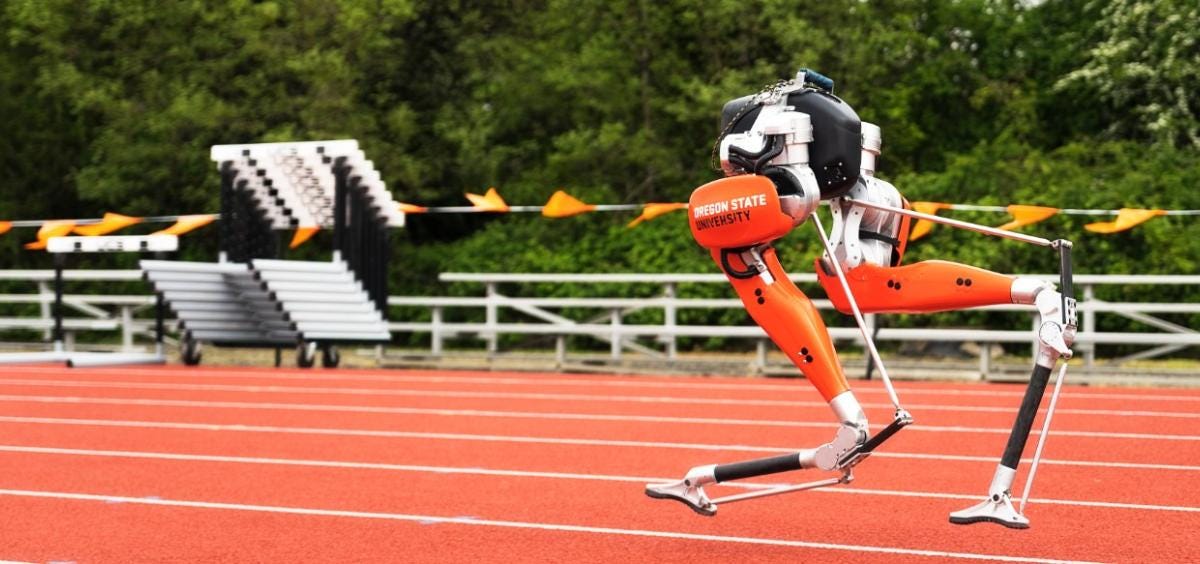
starting from a standing position and returning to that position after the sprint, with no falls.
accomplished through robot learning and almost a year of simulation, condensed down to a matter of weeks.
bon, ce n'est pas vraiment un robot, plus un automate, nuance : The robot has knees that bend like an ostrich’s and operates with no cameras or external sensors, essentially as if blind.
(et digression : cet robot mamouth n'est pas un robot, c'est un exosquelette piloté par l'humain à l'intérieur, "no sensors, no automation", nuance nuance)
The 100-meter record builds on earlier achievements by the robot, including traversing 5 kilometers in 2021 in just over 53 minutes
Cassie was developed with a 16-month, $1 million grant from the US' Defense Advanced Research Projects Agency, or DARPA.
How Elon Musk’s Starlink space satellites changed the war on the ground in Ukraine (source)
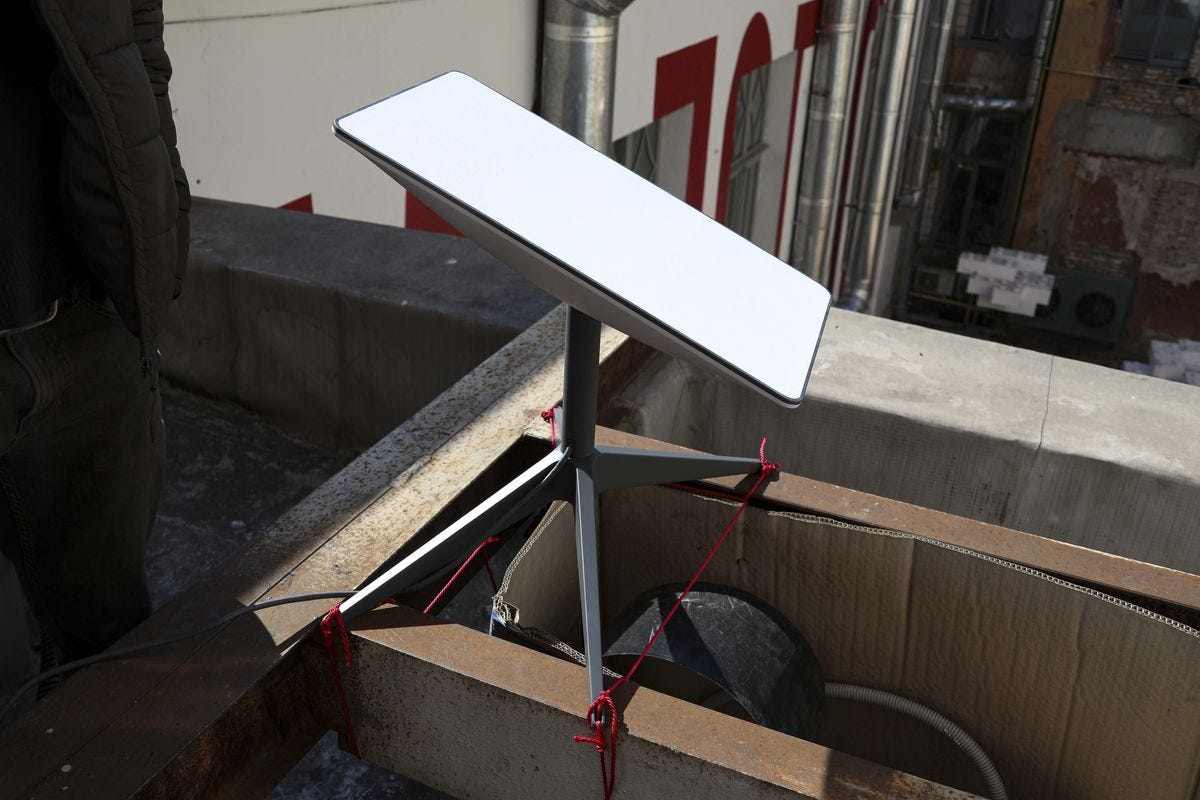
When planning a counterattack or artillery barrage, the solider dials up his superiors for last-minute orders via a rectangular white-and-gray Starlink satellite receiver concealed in a shallow pit in the garden of an abandoned cottage. The high-tech equipment is wired to a noisy generator that runs half of the day.
Ukrainian drones have relied on Starlink to drop bombs on Russian forward positions. People in besieged cities near the Russian border have stayed in touch with loved ones via the encrypted satellites.
All told, Starlink — and Ukraine’s use of the satellite network, both for its military and civilians — has thwarted Russia’s efforts to cut the Eastern European country off from the outside world, giving Kyiv a much-needed victory against Moscow in a conflict that shows no sign of ending.
The conflict in Ukraine also has provided Musk and SpaceX’s fledgling satellite network with a trial-by-fire that has whetted the appetite of many Western militaries.
Commanders have been impressed by the company’s ability, within days, to deliver thousands of backpack-sized satellite stations to the war-torn country and to keep them online despite increasingly sophisticated attacks from Russian hackers.
SpaceX CEO Elon Musk has clearly considered the possibility of Starlink becoming a target, saying earlier this year that "we can launch satellites faster than they can launch anti-satellites missiles."
“We’ve got more than 11,000 Starlink stations and they help us in our everyday fight on all the fronts,” Mykhailo Fedorov, Ukraine’s vice prime minister, told POLITICO. “We’re ready, even if there is no light, no fixed internet, through generators using Starlink, to renew any connection in Ukraine.”
Zelenskyy’s government had realized that internet access — both for the military and civilians — would be critical in the likely war to come. Soldiers needed a sure-fire way of staying in touch during the haze of war, and raw footage of Russian attacks, often uploaded by Ukrainians themselves via social media, has brought the conflict directly to people’s smartphones worldwide.
SpaceX, whose goal is to launch more than 40,000 satellites into so-called low Earth orbit in the coming years, quickly positioned roughly 50 satellites ready to be used in the Eastern European country.
Unlike traditional high-orbit satellites, which orbit thousands of miles above the earth, hovering over one point on the ground and beaming down radio signals, the new generation of low-orbit satellites relies on many more satellites working in a constellation. That configuration makes it more difficult, if not impossible, to take offline because an attacker would have to pinpoint all the satellites, at once, to cripple the entire system.
Starlink is more adaptable than alternatives because each device’s computer code can be quickly altered in response to possible hacks. Last month, Musk said the Kremlin was “ramping up” its cyberattacks on his network, and SpaceX has repeatedly rewritten its code to keep one step ahead of Russia.
Elon Musk on Oct 4th: “SpaceX’s out of pocket cost to enable & support Starlink in Ukraine is ~$80M so far.”
Ground stations, or hardware that linked Starlink’s satellites with local internet infrastructure, was housed in neighboring Poland to avoid Russian attack.
“The invasion happened on a Thursday and by the next day, Elon had called together a meeting and said, ‘I want to get Starlink up over Ukraine,’” said Butow of the U.S. Defense Innovation Unit.
“By Sunday, the link was active. By Monday, 500 ground terminals showed up in Ukraine. By Wednesday of that week, all but 25 of those terminals were alive and providing real-time data,” he added. “That’s commercial speed. That’s amazing.”
Starlink has kept Ukraine’s trains running. It has helped get liberated territories back online. It has been used to transmit government communications, including, on occasion, Mr Zelensky’s nightly broadcasts. But it has been most crucial as a secure form of communication on the battlefield, a soldier says, for everything from mobile command posts to drones. Ignore the tweets, he argues: “Starlink is our oxygen, you can’t just turn it off. If we tell Musk [to] piss off and take his Starlinks with him, our army would collapse into chaos.” (The Economist)
On Oct 13th, the Vice Prime Minister of Ukraine on Twitter: “Over 100 cruise missiles attacked 🇺🇦 energy and communications infrastructure. But with Starlink we quickly restored the connection in critical areas. Starlink continues to be an essential part of critical infrastructure.”
Les dernières newsletters :
L’addition ?
Cette newsletter est gratuite, si vous souhaitez m'encourager à continuer ce modeste travail de curation et de synthèse, vous pouvez prendre quelques secondes pour :
transférer cet email à un(e) ami(e)
étoiler cet email dans votre boîte mail
cliquer sur le coeur en bas d’email
Un grand merci d'avance ! 🙏
Ici pour s’inscrire et recevoir les prochains emails si on vous a transféré celui-ci.
Quelques mots sur le cuistot
J'ai écrit plus de 50 articles ces dernières années, à retrouver ici, dont une bonne partie publiés dans des médias comme le Journal du Net (mes chroniques ici), le Huffington Post, L'Express, Les Échos.
Retrouvez ici mon podcast Parlons Futur (ou taper "Parlons Futur" dans votre appli de podcast favorite), vous y trouverez entre autres des interviews et des résumés de livres (j’ai notamment pu mener un entretien avec Jacques Attali).
Je suis CEO et co-fondateur de l'agence digitale KRDS, nous avons des bureaux dans 6 pays entre la France et l'Asie. Je suis basé à Singapour (mon Linkedin, mon Twitter), également membre du think tank NXU.
Merci, et bon weekend !
Thomas